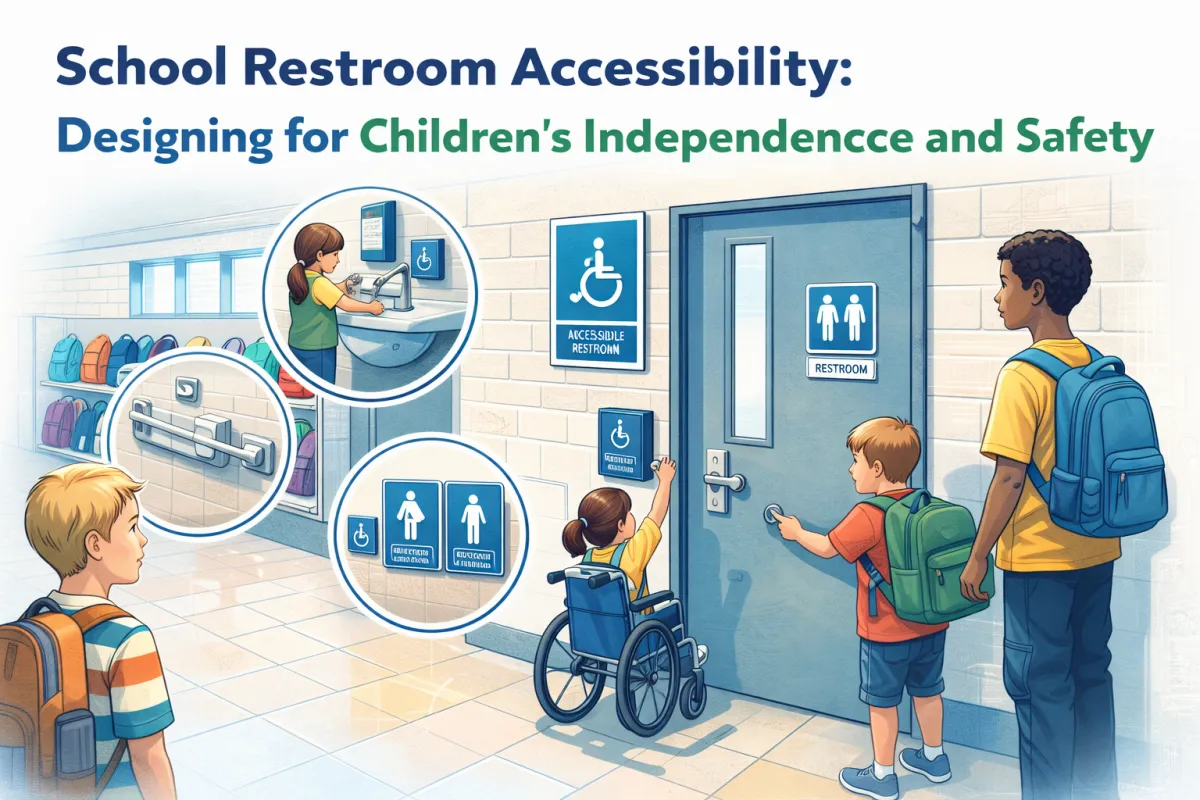
School Restroom Accessibility: Designing for Children’s Independence and Safety
School Restroom Accessibility: Designing for Children’s Independence and Safety
In educational facilities, restroom accessibility is often approached through a regulatory lens focused on minimum compliance. However, in schools, accessibility directly affects children’s independence, hygiene habits, and safety—making it both an operational and public health issue.
Many school restrooms technically meet accessibility standards, yet remain difficult for children to use independently. This article explores school restroom accessibility challenges, practical design considerations, and cost-effective solutions for both new construction and existing buildings.
1. Why School Restroom Accessibility Requires a Different Approach
Unlike other public buildings, schools serve a population with:
Rapidly changing physical development
Wide variations in height and reach
Limited strength and coordination
High frequency of restroom use
Designing for adults or wheelchair users alone does not address the full range of needs present in elementary and secondary schools.
2. Common Accessibility Gaps in School Restrooms
Recurring issues observed in schools include:
Sinks mounted at heights unreachable by children
Soap dispensers and hand dryers placed outside functional reach
Fixed fixtures designed for adults only
Students requiring assistance for basic hygiene tasks
These gaps reduce autonomy and increase supervision demands on staff.
3. Sink Height and Reach: A Core Accessibility Issue in Schools
Sink accessibility is one of the most critical factors affecting restroom usability for children.
Typical challenges:
ADA-compliant sinks suitable for wheelchair users but too high for children
Inconsistent reach ranges across fixtures
Limited space for installing multiple sink heights
Structural solutions (often costly):
Lowering counters
Installing multiple sink banks
Relocating plumbing
Because of budget and space constraints, many schools defer these changes.
4. Cost-Effective Adaptation Strategies for Existing Schools
Rather than fully rebuilding restrooms, schools increasingly rely on adaptive, non-structural solutions.
Key criteria for school environments:
Stability and anti-slip performance
Secure installation
Minimal impact on circulation
Durability in high-traffic use
Low maintenance requirements
When properly designed for institutional use, adaptive solutions allow schools to improve accessibility without major renovations.
5. Supporting Independence Without Compromising Compliance
Functional accessibility focuses on whether a space can be used independently and safely by its intended users.
In schools, this means:
Reducing reliance on adult assistance
Encouraging proper handwashing habits
Minimizing safety risks associated with climbing or improvised solutions
Adaptive elements that retract or fold away when not in use help preserve regulatory clearances while expanding usability.
6. The Role of Retractable and Adjustable Access Elements
Retractable access elements are increasingly considered in school restroom design because they:
Improve access to existing fixtures
Do not permanently obstruct circulation
Can be used only when needed
Avoid major plumbing modifications
Within this category, institutional-grade retractable step systems, such as Klimbo’s retractable steps, represent one option for improving sink accessibility for children while maintaining compliance when retracted.
These solutions should be evaluated as part of a broader accessibility strategy.
7. Designing for Long-Term Adaptability in Schools
School buildings often remain in service for decades. Accessibility solutions should therefore:
Adapt to different age groups over time
Remain functional through renovations
Support evolving accessibility standards
Flexible solutions provide greater long-term value than fixed, single-height designs.
8. FAQ – School Restroom Accessibility
How can schools improve restroom accessibility without full renovations?
Schools can use non-structural solutions such as adjustable or retractable access elements to improve reach and usability without modifying plumbing or layouts.
What is the recommended sink height for children in school restrooms?
There is no single standard height for all children. Accessibility strategies should account for a range of heights rather than relying on one fixed dimension.
Do ADA standards fully address children’s restroom needs?
ADA standards establish minimum requirements but are not specifically designed around children’s reach and height variability.
Are retractable access solutions compliant in school environments?
When properly designed and installed for institutional use, retractable solutions can complement compliant fixtures without interfering with required clearances.
