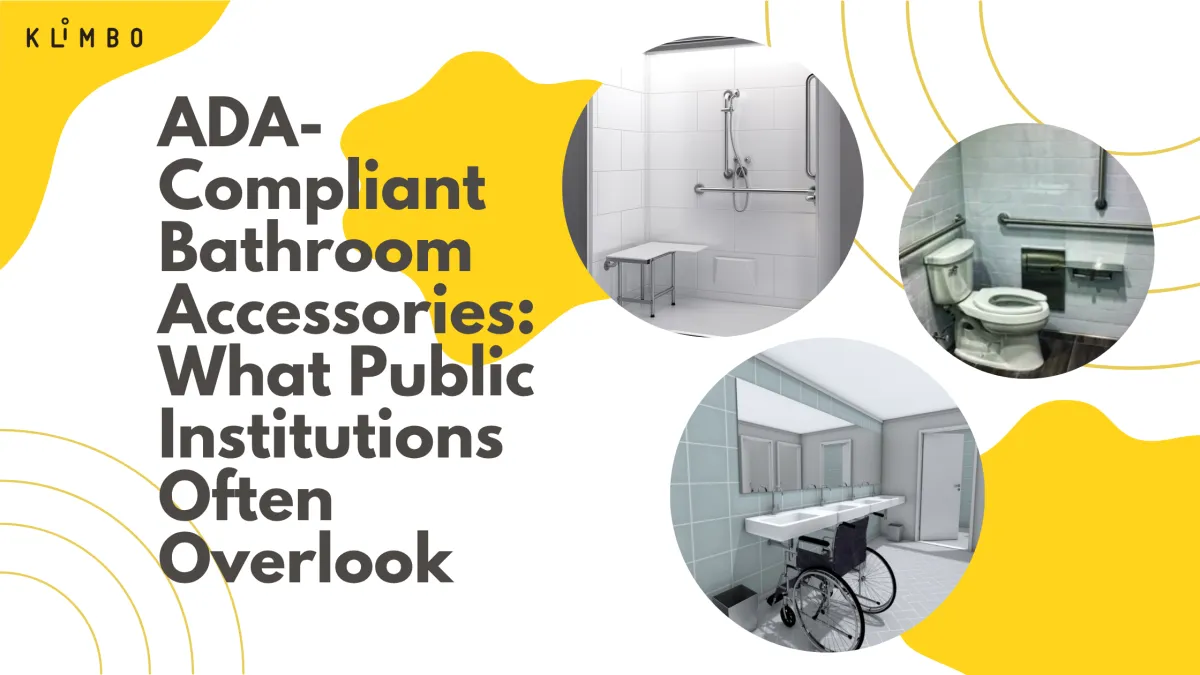
ADA Bathroom Accessibility for Children: What Most Buildings Miss
ADA Bathroom Accessibility for Children: What Most Buildings Miss
Most public buildings believe that if a restroom is ADA compliant, it is accessible for everyone.
In reality, ADA bathroom accessibility children is often overlooked.
A restroom may comply with accessibility regulations for adults with disabilities while still being difficult for children to use. Sinks, soap dispensers, mirrors and hand dryers are often installed at heights that are still too high for young children.
As a result, many children in airports, museums, libraries, restaurants and shopping centres cannot use the restroom independently.
For public buildings that want to create a truly family-friendly environment, ADA compliance is only the beginning.
What ADA Bathroom Accessibility Usually Covers
The ADA establishes minimum accessibility requirements for public restrooms in the United States. These standards are designed mainly for adults and wheelchair users.
In the United States, the Americans with Disabilities Act (ADA) establishes accessibility standards for public buildings.
ADA restroom guidelines typically focus on:
Wheelchair turning space
Grab bars
Accessible toilets
Sink height for wheelchair users
Reach ranges for accessories
Door width and circulation space
These standards are essential and improve accessibility for many people.
However, they are mainly designed around the needs of adults and wheelchair users.
Young children have very different needs.
A sink that meets ADA height requirements for an adult wheelchair user may still be too high for a four-year-old child.
ADA Compliance Is a Baseline, Not a Complete Solution
Many public institutions treat ADA compliance as a checklist.
If the restroom includes the required turning space, grab bars and accessible sink height, the project is often considered complete.
However, ADA compliance is only a minimum standard.
A restroom can fully comply with ADA requirements and still be difficult for children, shorter users and people with limited reach.
True accessibility means more than meeting the minimum measurements. It means creating a restroom that can be used safely and independently by all intended users.
Why ADA Bathroom Accessibility is not for Children
Children are shorter and often need different restroom features.
Even in an ADA-compliant restroom, children may still struggle to:
Reach the sink
Reach soap dispensers
Use the hand dryer
See themselves in the mirror
Reach a urinal
Open heavy restroom doors
Because of this, many children rely on parents to lift them or help them use the restroom.
That can reduce independence and create safety issues.
For example, children often try to climb on a sink edge or use an unstable object to reach the counter.
The Most Common Accessibility Problems for Children
Sinks and Counters Are Too High
In many public bathrooms, the sink and countertop are designed only for adults.
Even when the sink meets ADA requirements, it is often still too high for children.
This is one of the biggest gaps in ADA bathroom accessibility children.
Lowering an entire sink or countertop can improve access, but it is usually expensive because it requires:
Plumbing changes
New countertops
New wall finishes
Construction work
For buildings with an existing restroom, a commercial retractable step stool for public bathrooms is often the more practical solution.
It allows children to reach the existing sink safely without replacing the entire counter.
Soap Dispensers and Hand Dryers Are Often Installed Too High
Many public buildings improve access to the sink but forget about the accessories around it.
A child may be able to reach the faucet and still be unable to reach:
Soap dispensers
Paper towel dispensers
Hand dryers
For better ADA bathroom accessibility children, these accessories should be mounted lower whenever possible.
Lower accessories are inexpensive and easy to install compared with major renovations.
Mirrors Are Frequently Overlooked
Mirrors are another feature that many buildings overlook.
A mirror installed for adults may be completely unusable for children.
A lower mirror or an angled mirror allows children to:
See themselves while washing their hands
Check that they are clean
Feel more independent
This small improvement can make a restroom feel much more welcoming.
Lower Urinals Can Improve Accessibility for Boys
In men’s and family restrooms, urinals are often installed too high for young boys.
Adding one lower urinal is one of the simplest ways to improve child accessibility.
A lower urinal:
Makes the restroom easier to use independently
Reduces mess
Improves comfort for families
Lower urinals are especially useful in:
Airports
Sports arenas
Museums
Restaurants
Family restrooms
Functional Accessibility Matters More Than Minimum Compliance
The most important question is not only “Is this restroom compliant?” but also “Can children actually use it independently?”
Functional accessibility focuses on:
Real-world reach
Independent use
Safety and stability
Ease of use in busy public spaces
Many buildings meet ADA requirements while still forcing parents to lift children to the sink or help them reach soap dispensers and hand dryers.
That is why many facility managers and architects are beginning to go beyond standard ADA requirements and look for adaptable solutions.
Why Lower Counters Are Not Always the Best Retrofit Option
A lower counter can improve child accessibility, but it is not always the most practical solution.
A permanently lower sink may work better for children, but it can also be less comfortable for adults and may interfere with standard ADA layouts for wheelchair users.
In existing public bathrooms, lowering a counter usually requires a major renovation.
That may involve:
Replacing the sink
Moving the plumbing
Rebuilding the counter
Closing the restroom during construction
Because of these costs, many facilities choose not to make the change.
For existing bathrooms that already work well, a commercial retractable step stool for public bathrooms is often a better retrofit solution.
A retractable step stool:
Uses the existing sink and counter
Preserves clear floor space when not in use
Does not interfere with circulation space or ADA clearances
Costs less than replacing the counter
Requires only minor installation
Retracts when not in use
Does not create clutter or trip hazards
A built-in step stool for public bathrooms is often the most practical way to close the gap between ADA compliance and child accessibility.
Family Restrooms Should Go Beyond ADA Minimum Requirements
Many family restrooms technically meet accessibility standards, but they still do not work well for children.
A truly child-friendly restroom should include:
A retractable step stool
Lower soap dispensers
A lower mirror
One lower urinal
Easy-to-reach hand dryers
Space for parents and strollers
Non-slip flooring
Clear signage
These features make the restroom easier and safer for both children and adults.
ADA Compliance Does Not Always Mean Family-Friendly
Many public buildings stop once they meet the minimum requirements.
However, ADA bathroom accessibility children requires more than the minimum.
Families notice when a restroom is difficult for children to use.
Parents are more likely to remember a building positively when:
Children can wash their hands independently
The restroom feels safe
Fixtures are easy to reach
The space is designed for families
For airports, museums, shopping centres and restaurants, these details improve the customer experience.
The Best Way to Improve Child Accessibility in Existing Bathrooms
For new construction, it may be possible to install lower accessories and child-height features from the start. However, lowering an entire sink or counter is not always the best solution because it can reduce comfort and usability for adults and wheelchair users.
In many cases, a commercial retractable step stool for public bathrooms is still the better option, even in new construction. It allows the sink and counter to remain at a standard accessible height while still giving children safe access when needed.
For existing buildings, however, the best solution is usually a combination of:
Lower accessories
One lower urinal
Better mirror placement
A commercial retractable step stool for public bathrooms
This approach improves ADA bathroom accessibility children without requiring a complete renovation.
Conclusion
ADA compliance is important, but it does not automatically make a restroom accessible for children.
Many public bathrooms still overlook sinks, accessories and fixtures that are too high for young users.
For existing public buildings, a commercial retractable step stool for public bathrooms is often the simplest and most affordable way to improve ADA bathroom accessibility children.
FAQ
Does ADA require public bathrooms to be accessible for children?
No. ADA standards mainly focus on accessibility for adults with disabilities. Many ADA-compliant bathrooms are still difficult for children to use.
What is the biggest accessibility problem for children in public bathrooms?
The most common problem is that sinks and accessories are installed too high.
Are lower counters better than retractable step stools?
Lower counters can help, but they are usually more expensive and limit access to adults and people on a wheelchair. For existing bathrooms, retractable step stools are often a better retrofit and new construction option.
What features improve ADA bathroom accessibility children?
ower urinals, lower soap dispensers, lower mirrors and retractable step stools all improve accessibility.
What is the easiest way to improve child accessibility in an existing restroom?
For most public buildings, adding a commercial retractable step stool is the easiest and most cost-effective solution.
