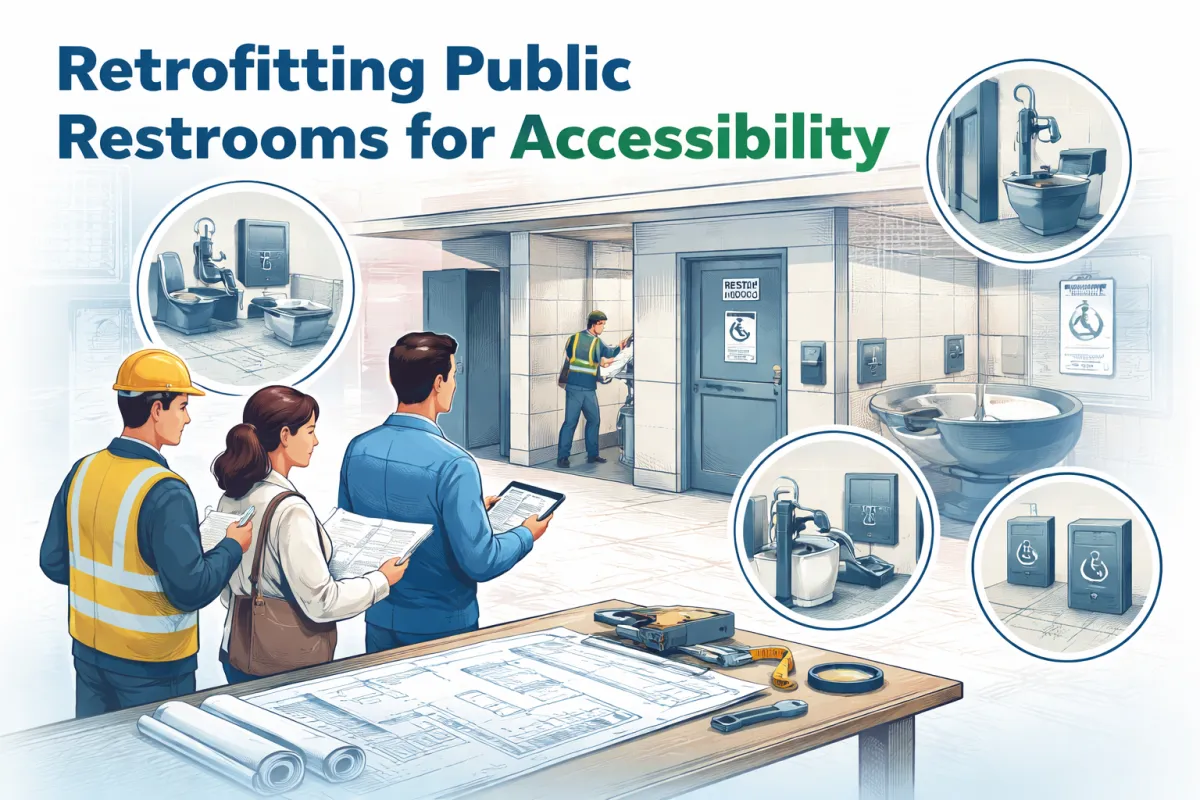
Retrofitting Public Restrooms for Accessibility: Practical Solutions for Existing Buildings
Retrofitting Public Restrooms for Accessibility: Practical Solutions for Existing Buildings
Across public and institutional buildings, accessibility challenges are rarely caused by new construction. They are most often rooted in existing infrastructure—schools, municipal buildings, transit facilities, hospitals, and cultural venues built decades ago under outdated standards.
While accessibility regulations continue to evolve, many institutions face the same question:
How can public restrooms be upgraded for accessibility without major renovations, excessive costs, or service disruptions?
This article explores the realities of accessibility retrofits in public restrooms and outlines practical, scalable strategies for improving usability in existing buildings.
1. The Reality of Aging Public Infrastructure
A significant portion of public buildings were designed before current accessibility standards were in place. As a result, many restrooms feature:
Fixed-height fixtures
Limited circulation space
Plumbing layouts that are difficult to modify
Structural constraints that limit design flexibility
Full reconstruction is often technically possible—but financially and operationally unrealistic for most institutions.
2. Why Full Renovations Are Often Not Feasible
Major restroom renovations typically involve:
Demolition of walls and floors
Plumbing relocation
Electrical and ventilation upgrades
Extended closures and service disruptions
High capital expenditures
For schools, hospitals, transit hubs, and municipal buildings, these interventions may conflict with budget cycles, occupancy requirements, and continuity of service.
As a result, many institutions seek incremental accessibility improvements rather than full rebuilds.
3. Common Accessibility Gaps in Existing Restrooms
In retrofit projects, recurring accessibility gaps include:
Sink heights that are inaccessible to children or shorter users
Accessories mounted outside functional reach
Limited flexibility for diverse user groups
Spaces that technically comply with regulations but are difficult to use independently
These gaps often persist because addressing them structurally would require extensive renovation.
4. The Value of Non-Structural Retrofit Solutions
Non-structural accessibility solutions focus on enhancing usability without altering core building systems.
Key characteristics include:
Minimal or no plumbing changes
Limited impact on circulation clearances
Fast installation
Compatibility with existing fixtures
Lower upfront and lifecycle costs
This approach allows institutions to improve accessibility while maintaining operational continuity.
5. Adaptive Solutions for Sink and Reach Accessibility
One of the most frequent retrofit challenges involves sink access and reach.
While lowering sinks or installing multiple fixture heights is effective, these options often exceed available budgets. Adaptive solutions offer an alternative by improving access to existing fixtures rather than replacing them.
When properly designed for commercial environments, adaptive elements can:
Improve reach for children and shorter users
Remain unobtrusive when not in use
Preserve accessibility for wheelchair users
Avoid permanent obstructions
6. Retractable and Adjustable Elements in Retrofit Projects
Retractable and adjustable accessibility elements are increasingly used in retrofit projects because they:
Address specific accessibility gaps without structural changes
Maintain compliance when retracted
Support multiple user profiles
Reduce long-term maintenance complexity
Within this category, retractable step systems designed for institutional use, such as Klimbo’s retractable steps, represent one possible solution for improving sink accessibility in existing restrooms—particularly where traditional renovations are not feasible.
As with all retrofit strategies, these solutions should be evaluated within a broader accessibility plan.
7. Prioritizing Impact in Accessibility Retrofits
Successful retrofit programs prioritize:
High-impact usability improvements
Cost efficiency
Durability in high-traffic environments
Minimal disruption to building users
Rather than aiming for perfection in a single project, institutions often achieve better outcomes through phased, targeted upgrades that address the most significant accessibility barriers first.
Conclusion
Retrofitting public restrooms for accessibility is rarely a matter of starting over. In most cases, it is about working intelligently within existing constraints.
While full renovations remain an option, they are often impractical for active public buildings. Non-structural and adaptive solutions, including retractable accessibility elements designed for commercial environments, allow institutions to close critical accessibility gaps—particularly around sink reach and usability—without the cost and disruption of major construction.
For facility managers and public decision-makers, the challenge is not simply upgrading restrooms, but doing so in a way that is practical, scalable, and responsive to real-world use.
