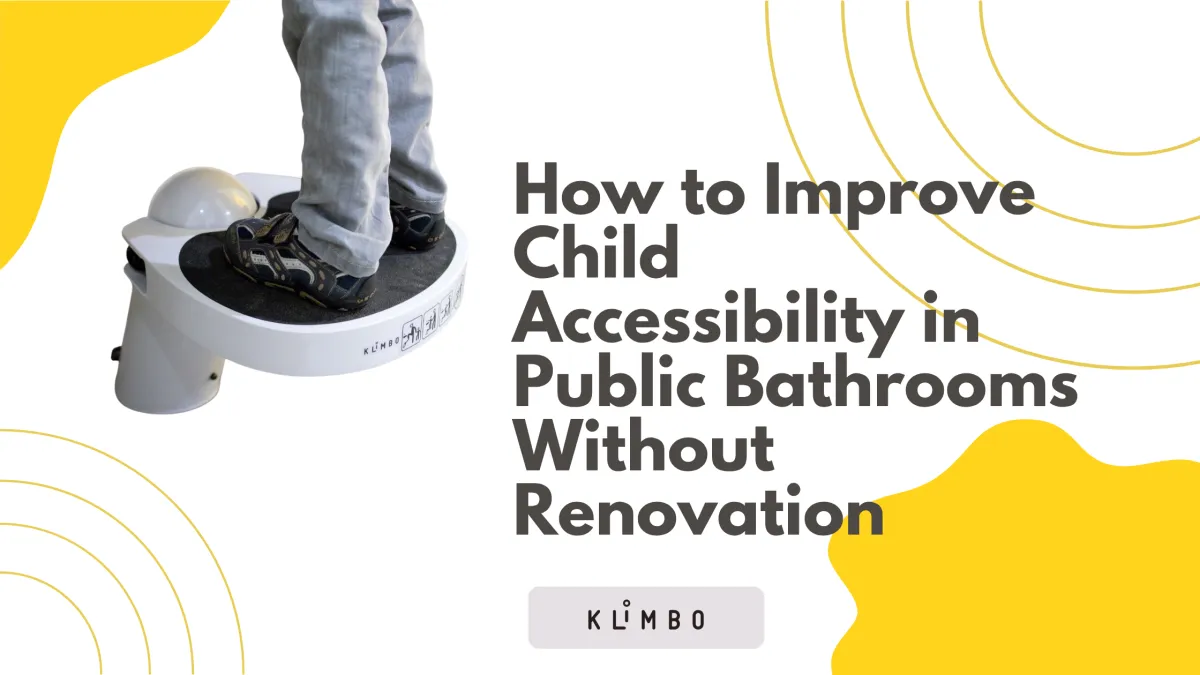
How to Improve Child Accessibility in Public Bathrooms Without Renovation
How to Improve Child Accessibility in Public Bathrooms Without Renovation
Most public bathrooms are not designed for children. As a result, many struggle to safely reach sinks, which directly impacts hygiene, safety, and independence. For facility managers and public buildings, this creates both operational challenges and increased risk.
Commercial step stools and integrated solutions provide a simple way to improve accessibility without costly renovations. These solutions help create safer, more hygienic environments in high-traffic public restrooms.
Poor hand hygiene remains a major issue in public environments. Studies show that only 19–31% of children follow proper handwashing practices, and about half of children in public restrooms do not wash their hands adequately.
This highlights the importance of accessible infrastructure that allows children to reach sinks safely and independently.
This is particularly important in high-traffic environments where safety, hygiene, and user experience must be consistently maintained.
Why Child Accessibility Is a Problem in Public Restrooms
In public environments such as schools, airports, and recreational facilities, bathroom fixtures are rarely adapted for children. This creates safety risks, limits independence, and can negatively impact hygiene.
Without proper accessibility solutions, children may climb on unstable surfaces, increasing the risk of falls and injuries.
Accessibility barriers directly affect hygiene outcomes. For example, 89% of parents report that sinks in public bathrooms are too high for children, making proper handwashing difficult.
As a result, children are less likely to wash their hands properly, increasing the risk of germ transmission in shared environments.
For facility managers, these issues also increase liability risks and maintenance challenges.
Key Requirements for Public Bathroom Step Stool Solutions
Safety and Stability
In high-traffic environments, safety is critical. Solutions must be stable, slip-resistant, and designed to prevent movement or tipping.Durability for Commercial Use
Unlike residential products, commercial step stools must withstand constant use. Materials should be resistant to wear, moisture, and cleaning chemicals.
Hygiene and Maintenance
Loose step stools often create hygiene issues. Fixed or integrated solutions reduce cleaning complexity and improve sanitation.
Handwashing is one of the most effective ways to prevent disease. According to the Centers for Disease Control and Prevention, proper handwashing can reduce diarrheal illness by 23–40% and respiratory infections by 16–21%.However, accessibility issues in public restrooms often prevent children from following these hygiene practices consistently.
Compliance and Operational Efficiency
In commercial buildings, solutions must also align with operational efficiency, minimizing maintenance while ensuring consistent usability.
Why Traditional Step Stools Are Not Ideal for Public Spaces
While portable step stools may work in residential settings, they present several issues in commercial environments:
They can be moved, misplaced, or stolen
They create tripping hazards
They are difficult to clean and maintain
For public restrooms, fixed or retractable solutions are significantly more effective. This is particularly problematic considering that only 58% of children report washing their hands after using the restroom, compared to 96% of adults.
In busy public spaces, inconsistency in placement or availability can significantly impact both safety and user experience.
Cost and Implementation Considerations
One of the main barriers to improving accessibility in public bathrooms is the perceived cost of renovation. However, structural modifications such as lowering sinks or redesigning layouts can be expensive, time-consuming, and disruptive to operations.
In contrast, step stool solutions offer a low-cost, fast-to-install alternative that requires no structural changes. This makes them particularly attractive for facilities looking to improve accessibility without downtime or major investment.
For facility managers, this represents a practical way to enhance safety and compliance while maintaining operational efficiency.
Best Solution: Integrated or Retractable Step Stools
Integrated step stools provide a permanent, safe, and hygienic solution for improving accessibility in public bathrooms.
These systems are designed to:
Stay securely in place
Support high usage environments
Maintain cleanliness standards
They are widely used in schools, public buildings, and commercial facilities where safety and efficiency are priorities. By improving accessibility, facilities can directly influence hygiene behavior, especially in environments where compliance is already low.
Real-World Use Cases
These solutions are commonly implemented in:
Schools and daycare centers
Airports and transportation hubs
Sports and recreational facilities
Municipal and public buildings
Fixed vs Portable Step Stools
When comparing solutions, fixed or integrated step stools offer clear advantages over portable options:
Consistent availability
Reduced safety risks
Easier maintenance and cleaning
Better suitability for high-traffic environments
Portable stools, while common in residential settings, are not designed for commercial use and often create operational challenges.
Key Benefits for Facility Managers and Public Spaces
Improved safety and reduced liability
Better hygiene compliance
Increased accessibility for children
No need for costly renovations
Enhanced user experience in public facilities
Improved hand hygiene in public environments can significantly reduce illness-related absenteeism, particularly in schools
Reduced maintenance interventions
Standardized accessibility across facilities
Improved compliance with hygiene protocols
The Impact of Accessibility on Hygiene BehaviorResearch consistently shows that accessibility plays a key role in hygiene compliance. When facilities are difficult to use, users—especially children—are less likely to follow proper hygiene practices.
Globally, only about 19% of people wash their hands properly with soap after using the toilet, highlighting a widespread behavioral gap.
In public buildings, improving accessibility is one of the simplest ways to increase compliance and reduce the spread of germs.
Choosing the Right Solution for Your Facility
When selecting a solution, facility managers should consider factors such as traffic volume, maintenance requirements, and long-term reliability.
In high-traffic public environments, fixed or integrated step stools are typically the most effective option, as they ensure consistent accessibility, reduce safety risks, and simplify maintenance operations.
Solutions that are specifically designed for commercial use will provide better long-term performance compared to residential alternatives.
Conclusion
Improving accessibility in public bathrooms does not require major renovations. With the right step stool solutions, facilities can provide a safer and more inclusive environment for children.
For schools, municipalities, and commercial buildings, investing in proper accessibility solutions is both a practical and cost-effective decision.
Choosing the right solution can significantly improve safety, hygiene, and accessibility in high-traffic public bathrooms and commercial environments.
Key Takeaways
Most public bathrooms are not adapted for children
Poor accessibility directly impacts hygiene and safety
Portable step stools are not suitable for commercial environments
Integrated solutions provide the safest and most reliable option
Accessibility improvements can be implemented without renovation
FAQ
What is the best way to make public bathrooms accessible for children?
Integrated or fixed step stool solutions are the most effective, as they improve safety, hygiene, and consistency.
Are portable step stools suitable for public restrooms?
No. They create safety risks, maintenance issues, and are not reliable in high-traffic environments.
Do step stools improve hygiene in public bathrooms?
Yes. By allowing children to reach sinks easily, they increase handwashing compliance.
