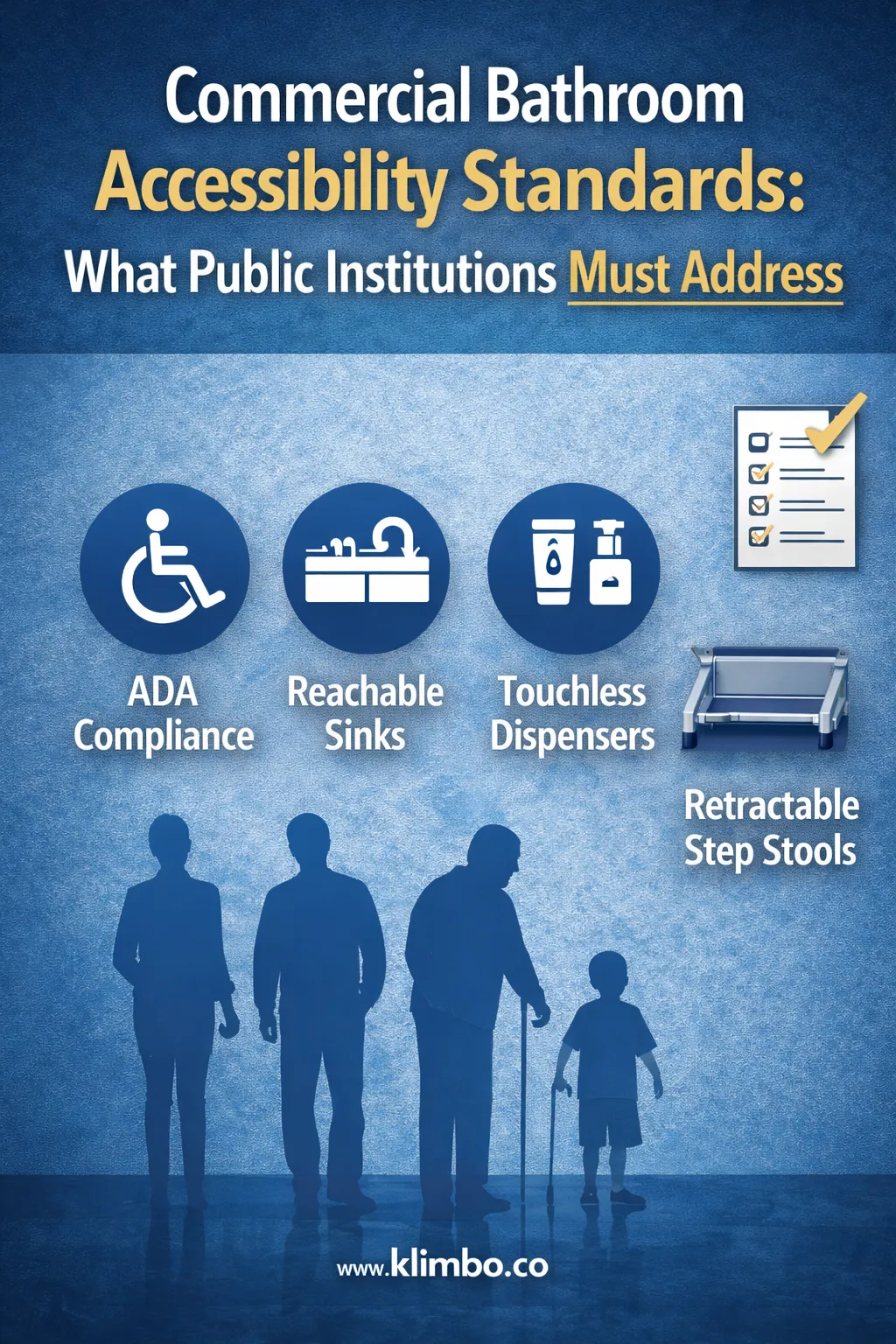
Commercial Bathroom Accessibility Standards: What Public Institutions Must Address
Commercial Bathroom Accessibility Standards: What Public Institutions Must Address
Accessibility in commercial and institutional bathrooms is no longer limited to minimum compliance. Public buildings are expected to serve users of all ages, abilities, and physical characteristics, while remaining cost-efficient and operationally sustainable. Yet, many projects still overlook critical accessibility gaps—particularly for children and users of shorter stature.
Below is a structured overview of the key accessibility standards that commercial bathrooms must address, along with practical considerations for implementation.
1. Clear Floor Space and Circulation
Accessibility standards consistently require sufficient clearance for mobility aids and safe circulation.
Key considerations include:
Adequate turning radius for wheelchairs
Obstacle-free access to sinks, toilets, and hand dryers
Door swing clearance that does not obstruct circulation paths
While these requirements are widely known, they often conflict with space constraints in existing buildings, especially during renovations.
2. Toilet and Stall Accessibility
Accessible toilet stalls must accommodate:
Proper seat height
Grab bar placement and load resistance
Side and rear transfer space
These elements are generally well integrated into modern designs. However, compliance often stops here, leaving other user needs unaddressed.
3. Sink Height and Reach Range: A Persistent Gap
One of the most common accessibility failures in commercial bathrooms concerns sink height and reachability.
Typical issues:
Sinks installed at a height suitable for adults but inaccessible to children
ADA-compliant sinks designed for wheelchair users but not usable by younger or shorter users
Soap dispensers, faucets, and hand dryers mounted beyond safe reach
Lowering sinks or installing multiple sink heights is technically effective but significantly increases costs:
Custom cabinetry
Plumbing relocation
Increased square footage requirements
Higher construction and maintenance expenses
As a result, many facilities accept partial accessibility rather than full usability.
4. Handwashing Accessibility and Public Health
Handwashing accessibility is directly linked to hygiene compliance, particularly in:
Schools and daycare facilities
Hospitals and clinics
High-traffic public buildings
If users cannot reach sinks independently:
Handwashing compliance decreases
Assistance is required, reducing autonomy
Hygiene standards are compromised
Accessibility standards increasingly emphasize functional usability, not just dimensional compliance.
5. Cost-Effective Adaptation Strategies
From an institutional perspective, accessibility solutions must balance:
Compliance
Durability
Budget constraints
Long-term maintenance
Structural modifications such as lowering counters or redesigning plumbing are effective but expensive and often impractical for retrofits.
An alternative approach is to adapt the user to the fixture, rather than redesigning the fixture itself.
6. Adjustable and Retractable Access Solutions
Step-based accessibility solutions are increasingly considered in commercial environments when properly designed for institutional use.
Key requirements include:
Stability and anti-slip surfaces
Secure wall mounting
Resistance to vandalism
Minimal impact on circulation space
Low maintenance
When these criteria are met, retractable step systems can:
Improve sink accessibility for children and shorter users
Preserve compliance for wheelchair users when retracted
Avoid costly plumbing and cabinetry modifications
In this context, retractable step solutions such as Klimbo steps represent one of several viable strategies to enhance accessibility without structural reconstruction.
7. Designing for Flexibility, Not Just Compliance
Modern accessibility standards increasingly align with universal design principles, aiming to serve:
Children
Adults
Seniors
Users with temporary or permanent mobility limitations
Fixed, single-height solutions rarely achieve this goal. Flexible, adaptive elements allow institutions to:
Serve a wider user base
Reduce retrofit costs
Extend the functional lifespan of restroom infrastructure
Conclusion
Commercial bathroom accessibility is not achieved through a single feature or product. It requires a holistic approach that addresses circulation, fixtures, reach ranges, hygiene, and user diversity.
While structural modifications remain an option, they are often costly and disruptive. Adaptive solutions, including well-designed retractable step systems, provide institutions with a practical way to close critical accessibility gaps—particularly around sink usability—without compromising budgets or compliance.
For public institutions, the challenge is no longer whether to improve accessibility, but how to do so efficiently, sustainably, and inclusively.
